The price comes from the shop and can change. Check price, size and delivery on the shop's page before you order.
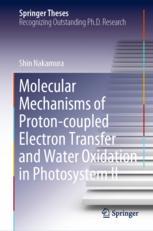
The book reviews photosynthetic water oxidation and proton-coupled electron transfer in photosystem, focusing on the molecular vibrations of amino acid residues and water molecules. Photosynthetic water oxidation performed by plants and cyanobacteria is essential for the sustenance of life on Earth, not only as an electron source for synthesizing sugars from CO2, but also as an O2 source in the atmosphere. Water oxidation takes place at the Mn4CaO5 cluster in photosystem II, where a series of electron transfer reactions coupled with proton transfer occur using light energy. The author addresses the unresolved mechanisms of photosynthetic water oxidation and relevant proton-coupled electron transfer reactions using a combined approach of experimental and computational methods such as Fourier transform infrared difference spectroscopy and quantum chemical calculations. The results show that protonation and hydrogen-bond structures of water molecules and amino acid residues in the protein play important roles in regulation of the electron and proton transfer reactions. These findings and the methodology make a significant contribution to our understanding the molecular mechanism of photosynthetic water oxidation.